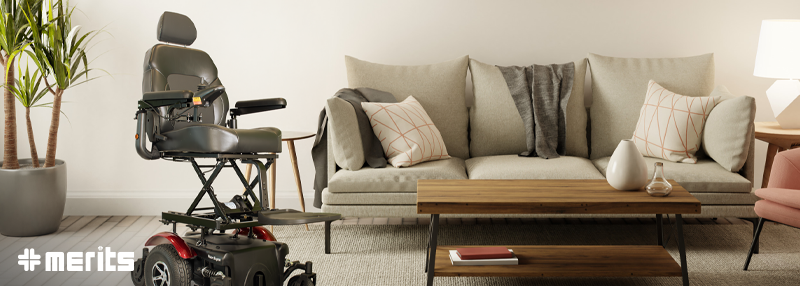
Previously considered an out-of-pocket luxury, seat elevation is now recognized by Medicare as a medically necessary benefit for many power wheelchair users. If you’re not yet leveraging this for your patients, or offering Group 2 chairs that include it, now is the time.
View the Flyer for More Seat Elevation Details
Quick Resource for Providers
Looking for product specifications or ordering details?
- View the Vision Sport K0830/K0831 Brochure
- View the Vision Super K0824/K0825 w/ K0108 Brochure
- Check the PDAC Product Classification List
What Is Seat Elevation and Why Is It Covered?
Seat elevation refers to the power-assisted feature that allows users to raise or lower the height of their wheelchair seat vertically. This function provides key mobility benefits, enabling users to:
- Transfer more safely
- Reach higher surfaces independently
- Reduce safety risks due to their environment or physical limitations
Key Reimbursement Update:
The 2023 Medicare reimbursement change acknowledges the medical necessity of seat elevation for users and now covers seat elevation for qualifying individuals using
- K0830/K0831: Group 2 Standard Power Wheelchair with seat elevation
- K0824/K0825 w/ K0108: Group 2 Heavy Duty Power Wheelchair with seat elevation
Important for Medicare Billing: K0830 and K0831 are the only HCPCS codes that can be used for Group 2 non-complex standard-weight power wheelchairs with seat elevation. To use these codes, the make and model must be listed on the PDAC Product Classification List with no discontinuation date.
Tip for Providers: When evaluating for seat elevation, document how it supports safe and efficient transfers, reduces fall risk, and/or facilitates reach to perform MRADLs — especially for patients with limited upper body strength or poor balance.
Why Seat Elevation Is Clinically Important
For years, seat elevation was seen as a “nice-to-have” feature. Now, it’s understood as a foundational part of functional mobility for many patients — especially those with limited strength, balance, or transfer ability.
Here’s why it matters:
1. Supports Safer Transfers
Whether moving from bed to chair, toilet to chair, or into a vehicle, transfer safety is a top priority. Being able to raise the seat to match the transfer height can:
- Reduce fall risk
- Increase user independence and stamina
- Minimize caregiver strain and injury
2. Improves Access to Environments
Seat elevation allows users to reach items on shelves, counters, or cabinets — empowering them to:
- Prepare meals
- Maintain hygiene routines
- Perform household tasks
3. Promotes Social and Psychological Wellness
Elevating to eye level during conversations or group settings:
- Improves communication and visibility
- Reduces feelings of isolation
- Supports dignity and self-esteem
4. Reduces Long-Term Injury Risk
Poor ergonomics during transfers can lead to injuries over time. Seat elevation aligns the user with surfaces and supports:
- Proper transfer mechanics
- Less strain on shoulders, wrists, and spine
- Prevention of long-term joint damage from unsafe movement patterns
Merits Power Wheelchairs with Seat Elevation: Vision Sport vs. Vision Super
Merits Health Products offers two flagship Group 2 models that support seat elevation, both of which are officially PDAC-approved – making billing and compliance simpler for providers.
|
Need Specs or Product Forms?
Supporting Documentation and Service Tools
Codes to Know:
- K0830/K0831: Group 2 Standard with seat elevation
- K0824/K0825 w/ K0108: Group 2 Heavy Duty with seat elevation
What to Document:
- Transfer difficulties or fall risks
- Reach limitations for MRADLs
- PT or OT assessments detailing functional limitations
Merits Provider Support Includes:
- Product brochures and order forms
- Quick access to clinical and tech support from our team
- U.S.-based fulfillment and repair guidance
- Durable, service-friendly designs
Visit the Merits website for order forms, owners’ manuals, or additional help from our team.
Contact a Merits Rep for More Info
FAQs: What Providers Want to Know
Q: Who qualifies for seat elevation under Medicare?
A: Medicare may cover seat elevation for patients who require it to safely perform mobility-related activities of daily living (MRADLs), such as transferring from a wheelchair to a bed or toilet, reaching overhead objects, or performing hygiene tasks. Clinical documentation is required to support medical necessity.
Q: What is the difference between the Vision Sport and Vision Super?
A: Vision Sport is a standard powerchair for light to moderate users. Vision Super offers greater weight capacity and is ideal for heavier users requiring more stability.
Q: Is seat elevation available for patients who weigh up to 300 lbs?
A: Yes. The Vision Sport (K0830/K0831) weight capacity is 300 lbs, while the Vision Super (K0824/K0825 w/ K0108) supports up to 400 lbs with power seat elevation as an optional feature. Note: A user weighing 285 lbs or more may qualify for a heavy-duty base – they do not need to reach 300 lbs.
A Reimbursable Benefit That Truly Elevates Care
Seat elevation is more than a mobility upgrade — it’s a clinically significant function that improves safety, reduces injury risk, and supports independence in daily life.
With Merits’ Vision Sport and Vision Super, you gain:
- Power wheelchairs that meet clinical standards
- Practical serviceability for long-term use
- Built-in features that match user needs and support therapy outcomes
Enhance Patient Care Today! Download an Order Form
Take the Next Step
Help your clients live more independently — and help your service stay at the forefront of assistive mobility.