Two wheelchair cushions can both be described as “pressure relief,” but perform very differently once posture, endurance, transfer needs, and skin risk enter the picture.
That is usually the real decision point in seating. It is rarely about finding the single “best” cushion category. It is about finding the cushion that best matches the user’s sitting presentation, pressure risk, daily routine, and tolerance over time.
That is exactly where foam vs. gel vs. air wheelchair cushion comparisons get more useful. Foam, gel, and wheelchair cushions serve different purposes based on pressure injury risk, immersion needs, pelvic support, adjustability, and maintenance. Merits’ Precision Comfort line includes gel, deep-well gel, and adjustable air options, all on a durable foam base, designed to support users with mild to complex seating needs, and to work across Merits and many third-party wheelchair bases.
Why Cushion Selection Is About More Than Comfort
In clinical seating, cushion choice is not just about what feels soft or supportive during a quick trial. A pressure relief wheelchair cushion is usually selected for a combination of pressure redistribution, pelvic support, posture control, shear reduction, microclimate support, and function over time. The Precision Comfort cushion line from Merits is engineered to promote proper weight distribution, pelvic alignment, and microclimate control, with models designed to meet different clinical needs.
That matters because a cushion that feels good for 10 minutes may not hold up after several hours of sitting. A user may start the day upright and comfortable, then slide into posterior pelvic tilt, lose lower-extremity stability, or develop more concentrated loading at the sacrum or ischial tuberosities by mid-afternoon. That is why cushion selection should stay function-first and real-world, not spec-sheet-first.
Related: Precision Comfort: Seating & Positioning for Better Outcomes
What Clinicians Are Really Comparing When They Compare Air vs. Gel vs. Deep Well Cushions
Pressure relief and immersion
Immersion simply means how much the user settles into the cushion. Higher-risk users often need better offloading around the ischial tuberosities and coccyx, not just a surface that feels padded. More immersion can help distribute load over a broader surface area, but only when it is paired with enough support to keep posture from collapsing.
Positioning and stability
Some users need more than pressure relief. They also need pelvic guidance, lower-extremity stability, or help avoiding sacral sitting. In those cases, the question becomes less about softness and more about whether the cushion can support postural considerations without giving up too much immersion.
Maintenance and consistency
Some cushions are more set-and-forget than others. Others require more precision and more follow-through. Air-based designs, in particular, can offer strong offloading and customization, but they also ask more of the setup and monitoring process.
Daily function
Transfers, propulsion, reaching, sitting tolerance, and caregiver routines all matter. A cushion can perform well on pressure mapping and still be a poor fit if it makes transfers harder, feels too unstable for the user, or loses effectiveness because it is not maintained consistently.
When a Gel Wheelchair Cushion Makes the Most Sense
A gel wheelchair cushion is often a strong middle-ground option when the user needs more pressure management than a basic general-use foam surface, but still benefits from a supportive, stable base.
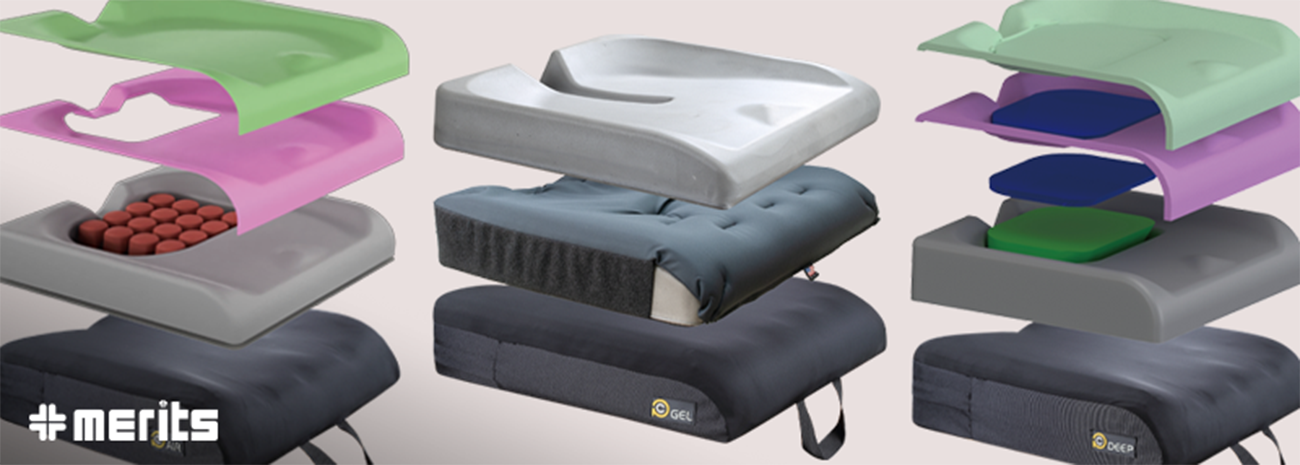
Merits’ PC Gel Cushion has an ergonomic foam base with an immersive gel overlay layer and a rear cutout that helps offload the coccyx and sacrum. It’s an entry-level skin protection option that also supports pelvic alignment and microclimate control.
In practice, that makes sense for users who need better pressure redistribution plus pelvic support, have mild to moderate skin risk, or will do better with a lower-maintenance setup than an adjustable air cushion. It can also be a good fit when the clinician wants a balance between immersion and stability rather than the more floating feel some users experience on air.
Best-fit examples include users with:
- Early skin protection needs
- Mild postural asymmetry
- Coccyx or sacral offloading needs
- Or seating plans where consistency matters more than high adjustability
The tradeoff is that gel may not offer the same level of customizable immersion as air. It still needs to be matched carefully to posture and seating goals, and it should not be treated as the best option for every higher-risk user.
When a Deep-Well Cushion Is the Better Choice
“Deep well” is one of those terms that sounds technical until you see what it solves. In practical terms, a deep-well cushion creates more immersion and helps manage loading around the ischial tuberosities and coccyx while supporting posture more intentionally.
The PC Deep Cushion features a deep well with a specialized silicone gel insert, making it highly immersive for supporting the user’s ischial tuberosities and coccyx and optimizing pressure redistribution. It’s supportive for long-term sitting and designed to reduce shear and sacral pressure risk.
That makes deep-well designs especially useful for:
- Users with higher pressure risk who still need meaningful postural support
- Can also be a strong option for users prone to sacral sitting or sliding
- Or for long-term sitters who need pressure relief and stability working together
A deep-well cushion often helps when the standard gel category is not immersive enough, but a highly adjustable air surface may not be the best match for function, setup, or stability.
When an Air Wheelchair Cushion Is the Right Fit
Air cushions are often chosen when pressure relief and customizable immersion are the highest priorities.
The PC Air+ Cushion is a cushion with a manually adjustable air bladder insert for customizable immersion and offloading. It also includes a deep-well design with ergonomic contours to help prevent sacral sitting, plus a gel overlay layer intended to help prevent bottoming out. It’s well suited for users at high risk of pressure injury or progressive conditions.
Air cushions can be more consistently effective in reducing interface pressure than gel and foam cushions, while also emphasizing the importance of individualized evaluation.
In real-world terms, air can be a strong fit for:
- Users at high risk of pressure injury
- Users with progressive diagnoses
- Users who need significant offloading
- Or users whose seating needs fluctuate and benefit from adjustability
The tradeoff is that setup matters more. Air cushions require monitoring and maintenance, and over- or under-inflation can change both performance and stability. Some users also feel less secure on air if the cushion is not adjusted correctly.
Air vs. Gel vs. Deep Well Cushions: A Practical Comparison
|
Cushion Type |
Best Fit When… |
Key Strengths |
Key Considerations |
|
Gel Cushions |
You want a
balance of comfort and ease of use |
Good blend of
support and pressure relief; generally lower maintenance |
Less adjustable
than air; may not offload as aggressively for high-risk users |
|
Deep‑Well Cushions |
Immersion,
offloading, and posture all need to work together |
Strong pelvic
positioning, immersion, and intentional pressure distribution |
Requires
thoughtful selection and fitting to match the user |
|
Air Cushions |
Pressure injury
risk is highest and fine-tuning matters |
Excellent
pressure redistribution and adjustability |
Higher
maintenance; performance depends heavily on setup and monitoring |
Bottom line: No cushion type is universally “best.”
The right choice depends on how the cushion’s behavior aligns with the user’s
pressure profile, pelvic presentation, and daily routine.
Common Cushion Selection Mistakes That Cause Problems Later
A lot of cushion problems show up after delivery, not during the first evaluation.
Common mistakes include:
- Choosing based on comfort alone
- Prioritizing pressure relief without enough stability
- Prioritizing stability without enough immersion
- Ignoring sacral sitting and pelvic position
- Assuming an air cushion will work without setup checks
- Treating the cushion as the whole seating solution instead of one part of a broader positioning system
That last point matters. This is where Precision Comfort stands out, as it’s a full seating and positioning line that includes cushions, backrests, and accessories, not just isolated components.
How to Decide Which Precision Comfort Cushion to Trial First
Start with skin risk. Look at pressure injury history, current redness, sensation, and how long the user sits each day.
Then look at posture and pelvic presentation. Is there posterior pelvic tilt, sliding, sacral sitting, asymmetry, or a need for lower-extremity stability?
Then look at daily realities. How does the user transfer? How much caregiver involvement is there? How likely is consistent maintenance? What does the home environment allow?
Finally, validate with real-world tasks. The best cushion trial is not just a quick sitting test. It is a look at sitting tolerance, posture over time, transfer quality, and skin response after meaningful use.
Where Precision Comfort Fits Into a Broader Seating and Positioning Strategy
Precision Comfort is not just a cushion line. It is part of a broader seating and positioning system that includes backrests and accessories, with cross-compatibility across Merits wheelchairs and many third-party power and custom manual bases. It is known for its adaptability, clinical performance, and configuration without the complexity of fully custom builds.
That matters because cushion outcomes usually improve when back support, pelvic positioning, and accessories are considered together instead of being handled one component at a time.
The Best Cushion Is the One That Matches the User, Not the Category
If you are trying to decide how to choose a wheelchair cushion, start with the user, not the material category.
Gel is often a good balance of support, pressure relief, and lower-maintenance use. Deep-well cushions are often the better choice when immersion, offloading, and postural support need to work together. Air cushions are often the best match when pressure risk is highest and adjustability matters most.
The right choice depends on skin risk, pelvic stability, posture, and how the cushion performs over the full day. That is where Precision Comfort seating can be most useful: not as a one-size-fits-all answer, but as a set of options designed to support more individualized seating decisions.
FAQ: Air vs. Gel vs. Deep Well Wheelchair Cushions
What is the difference between an air and gel wheelchair cushion?
An air wheelchair cushion usually offers more adjustability
and customizable immersion, which can help with higher pressure-risk users. A
gel wheelchair cushion usually offers a more stable, lower-maintenance feel
while still supporting pressure relief and positioning.
What does a deep-well wheelchair cushion do?
A deep-well wheelchair cushion creates more immersion around
the pelvis and helps offload pressure around the ischial tuberosities and
coccyx. It can also help reduce sacral sitting and support better long-term
positioning.
Which wheelchair cushion is best for pressure sores?
There is no single best cushion for every user. Air cushions
are often favored for users at higher risk because they can provide stronger
pressure redistribution, but fit, posture, and individualized evaluation still
matter.
Are gel wheelchair cushions good for pelvic positioning?
They can be. Merits’ PC Gel cushion supports pelvic
alignment while also providing an immersive gel overlay, and coccyx and sacrum
offloading.
Do air wheelchair cushions require more maintenance?
Yes. Because air cushions depend on proper inflation and
adjustment, they generally require more regular setup checks than gel-based
options.
How do I know if a user needs a deep-well cushion?
A deep-well cushion may make sense when the user has higher
immersion needs, is prone to sacral sitting, needs better offloading at the ITs
and coccyx, or needs pressure relief and posture support to work together more
effectively.
Can one cushion solve pressure relief and posture at the same time?
A cushion can support both, but it works best as part of a
broader seating and positioning strategy that includes back support, pelvic
positioning, and the right overall setup.